Военная организация поздней римской империи в 253—353 гг. От реформ императора Галлиена до периода тетрархии (253—305) - Евгений Александрович Мехамадиев Страница 137
- Категория: Научные и научно-популярные книги / История
- Автор: Евгений Александрович Мехамадиев
- Страниц: 182
- Добавлено: 2026-05-23 09:08:27
Внимание! Книга может содержать контент только для совершеннолетних. Для несовершеннолетних просмотр данного контента СТРОГО ЗАПРЕЩЕН! Если в книге присутствует наличие пропаганды ЛГБТ и другого, запрещенного контента - просьба написать на почту pbn.book@yandex.ru для удаления материала
Военная организация поздней римской империи в 253—353 гг. От реформ императора Галлиена до периода тетрархии (253—305) - Евгений Александрович Мехамадиев краткое содержание
Прочтите описание перед тем, как прочитать онлайн книгу «Военная организация поздней римской империи в 253—353 гг. От реформ императора Галлиена до периода тетрархии (253—305) - Евгений Александрович Мехамадиев» бесплатно полную версию:Предлагаемая вниманию читателя книга посвящена сложному переломному периоду в истории поздней Римской империи — второй половине III в., времени от реформ императора Галлиена до правления императора Диоклетиана, т. е. до эпохи Тетрархии. Особенность этой книги заключается в том, что впервые в отечественной и западной историографии автор системно и в строгом хронологическом порядке рассматривает собственно военную историю поздней Римской империи и все основные военные кампании, развернувшиеся с 253 по 305 г.
Внимание автора сконцентрировано на организационной структуре, т. е. внутреннем устройстве пограничных и полевых (экспедиционных) региональных армий той эпохи. Изучается механизм формирования тех или иных армий, впервые в отечественной науке детально прослеживается и восстанавливается история отдельных войсковых подразделений тех или иных региональных армий: какие подразделения входили в состав армии, как войсковые образования перемещались территориально, как эти перемещения влияли на изменение их ранга и статуса.
Главными источниками для исследования служили надписи и папирусы, сопоставленные с известными нарративными источниками. Автор привлек к анализу все известные на сегодня документы, упоминающие позднеримские войсковые соединения, что позволило пересмотреть многие вопросы развития военного дела указанного периода и предложить новый образ позднеримской армии.
Книга предназначена для специалистов по истории Античности и Византии и всех тех, кто интересуется военной историей поздней Римской империи.
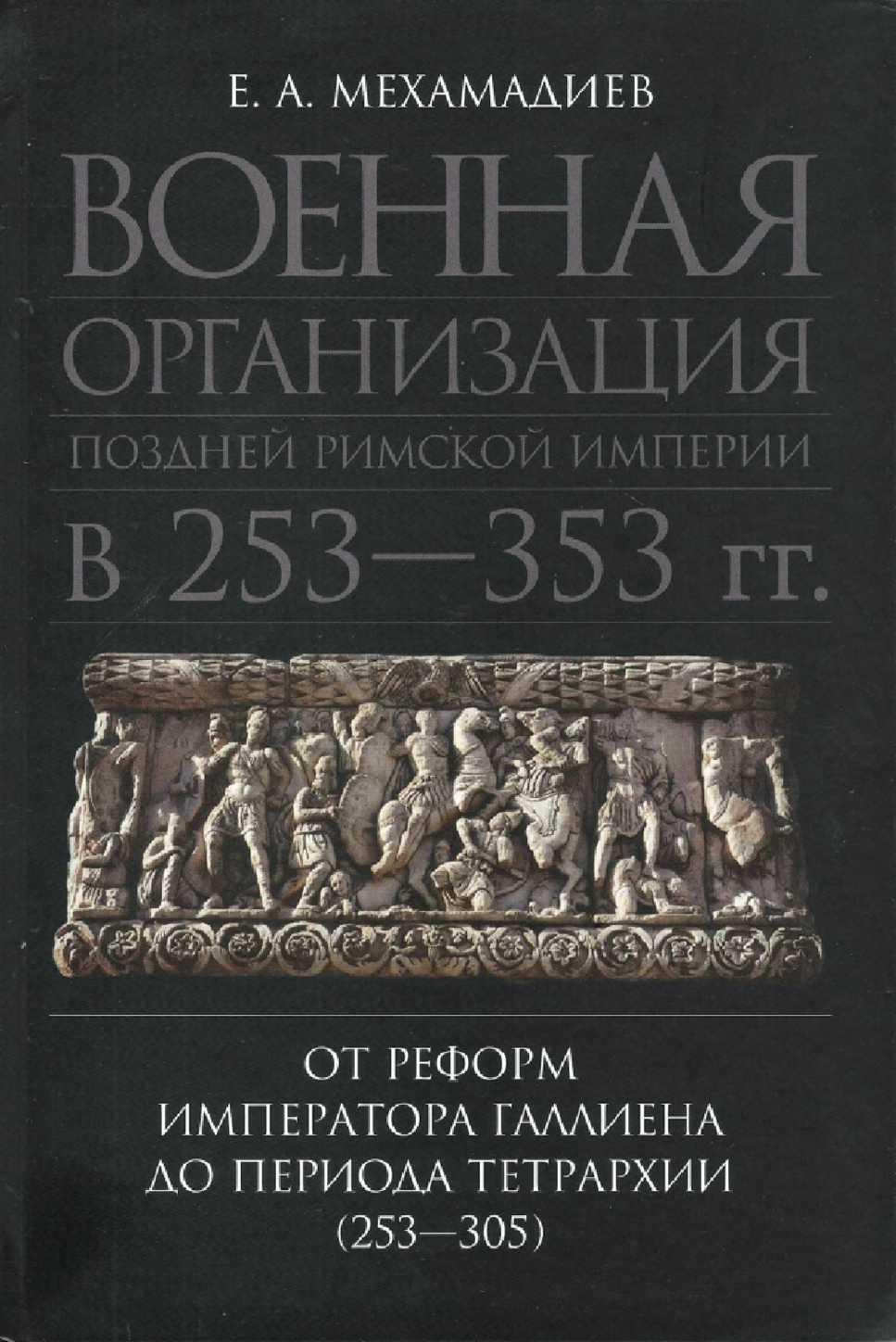
На первой странице обложки: Победа римлян под командованием Цезаря Максимина Галерия над персами в 298 г.: изображение на центральной части барельефа с триумфальной арки Галерия в городе Салоники (Греция)
Военная организация поздней римской империи в 253—353 гг. От реформ императора Галлиена до периода тетрархии (253—305) - Евгений Александрович Мехамадиев читать онлайн бесплатно
These were military ethnic units, their staff consisted of young men from noble families, representatives of local aristocracy of tribes and people, who supported the Persians in 298. More presicely, we mean the I ala of the Hiberi, the IXth cohorts of the Tzani and the I ala of the Avasgi. Units enumerated were composed of local aristocracy from these tribes and people.
Moreover, Diocletian located at the south coast of the Black sea, in Trebizond, a new legion, that is I Pontica, this legion had to defence the province of Pontus (Trebizond was an administratuive centre of this province) from possible incursions of the tribe of the Tzani. A garrison of the First Pontic legion, which stood in Trebizond, was an important structural element of the Roman defence system within the Armenian highland. Another important element was a vexillation of the Martenses («soldiers of Mars»), which occupied a territory of the province of Minor Armenia.
As for the Roman army itself, which defeated the Parsians in 298, we concluded that this army consisted of vexillations detached from old Danubian frontier legions, i. e. XI Claudia, VII Claudia, I Italica, IV Flavia, I Illyrica and V Macedonica. An effective of this military group was 25 000 men.
In 298–305 Diocletian allocated at the Near East front a whole series of new military units and at the same time he reinforced some old units, which had served there since early Principate. We can enumerate among old legions three frontier units, that are III Cyrenaica, I Illyrica and III Gallica. We have to add that after 298 Diocletian tranferred the Third legion of Cyrenaica in the province of Mesopotamia. Also we have to extend a list of old legions by VI Ferrata legion and X Fretensis legion, both units occupied a territory of Palestine.
Finally, a whole series of epigraphic data evidence that at the same time Diocletian formed and allocated at the Near East, mainly in Arabia Petraea and Palestine, some new alae and cohorts, among them we have to call the first new cohort (cohors prima nova), an ala from the fortress of Costia, i. e. ala located in this fortress (ala Costia), and also the second cohort of the Galatians (cohors II Galatarum).
Besides alae and cohorts, Diocletian recruited and allocated at the Near East many units of a mobile cavalry entitled equites, their full and official name was equites promoti indigenae («a local promoted cavalry»). These cavalry units were formed from the local population of Syria and Arabia, mainly from the local nomadic tribes.
Military reforms of Diocletian affected not only Near East provinces, they intensively developed in Egypt, especially after 298. Between 298 and 305 Diocletian formed and located in Egypt two new legions, that are III Diocletiana and I Maximiana, moreover, by Diocletian's order Egypt received a vexillation created in Gaul. We mean a vexillation which earlier had been an integral part of the legion II Flavia Constantia, the legion itself served in Gaul.
But military reforms managed by Diocletian in Egypt were naturally connected to the similar measures of Diocletian at the Near East frontier. Diocletian moved from the Roman-Persian frontier to Egypt some military units formed in Syria and Arabia or recruited from the Persian prisoners captured during the Roman-Persian war of 298. We have to call among these units the archers from the Syrian city of Emesa, a combined vexillation formed from a staff of two legions, that are I Illyrica and III Gallica, and finally a vexillation of Parthian archers together with the so-called III ala of the Assyrians.
All sources regarded in our book led us to conclusion that during the reign of Diocletian all military forces, which occupied the Roman Near East were principally a frontier army, they represented only the frontier military units, that are legions, vexillations, alae and cohorts. No one province had any of expeditional forces, no one province had any units from mobile imperial field guards. By other words, Diocletian didn't move at the Near East any units from his personal imperial bodyguard. The only one expeditional military group, which located and fought at the Near East during 293–305 was a military corps of Caesar Galerius composed of vexillations from Danubian frontier legions. Initially this military corps occupied Mesopotamia and then these vexillations moved to the south, in Arabia Petraea. But this group of vexillation located at the Near East frontier only during a short period of time, from Spring to Autumn of 298. After a desicive victory over the Persians Galerius' troops returned in their home provinces at the Danubian frontier. We have to stress that only two small vexillations rested at the Near East and continued to be there till the end of the IVth century, we mean vexillations of the Xlth legion of Claudia and the Vth legion of Macedonica.
Список источников и литературы
I. Источники
1.1. Законодательные
Collectio librorum iuris anteiustiniani in usum scholarum / Ed. P. Krueger, Th. Mommsen. Vol. Ill: Fragmenta Vaticana, Mosaicarum et Romanarum legum collatio. Berolini, 1890.
Corpus iuris civilis. Volumen secundum: Codex lustinianus / Ed. P. Krueger. Berolini, 1906.
Theodosiani libri XVI cum constitutionibus Sirmondianis / Ed. Th. Mommsen. Voluminis I pars posterior: Textus cum apparatu. Berolini, 1905.
1.2. Надписи
Bauzou Th. Epigraphie et toponymie: le cas de la Palmyrène du sud-ouest // Syria. 1993. Vol. 70. Fasc. 1/2. P. 27–50.
Besnier Μ. Inscriptions et monuments de Lambèse et des environs // Mélanges d'archéologie et d'histoire. 1898. Vol. 18. P. 451–489.
Catalogue général des Antiquités Egyptiennes du Musée du Caire. Greek Inscriptions / Ed. by J. G. Milne. Oxford, 1905.
Corpus Inscriptionum Graecarum / Ed. E. Curtius et A. Kirchhoff. Vol. IV. Berolini, 1877.
Corpus Inscriptionum Latinarum. Vol. I–XVI. Berlin, 1863–1959.
Darby R. Aufidius Priscus, the cohors secunda Galatarum, and Diocletian's re-organization of Arabia and Palaestina: the new tetrarchic inscription from
Жалоба
Напишите нам, и мы в срочном порядке примем меры.